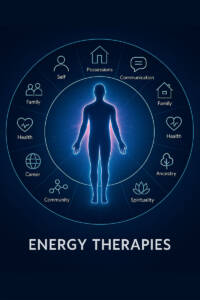
The main purpose of therapies is to balance the relationship between body, mind, and consciousness. In other words, balancing bodily energies, emotions, thoughts, beliefs, habits, and awareness. At a fundamental level, it is the relationship with ourselves, meaning the relationship between “I”, “Self”, and “Essence”. The body (“I”) feels emotions, the mind (“Self”) creates thoughts and beliefs, and consciousness (“Essence”) manifests as present-moment awareness.
In this relationship, it is very important to be aware of how we treat ourselves, how we judge, how we perceive obstacles, how much joy we find in life, how we realise our plans and goals, how satisfied we are with our living conditions, how we reach our higher potential, how much time we spend with ourselves, and how we behave in different relationships.
All these conditions may affect our health as well. Any awareness or any change in these states will positively affect ourselves first, and then our loved ones.
Our mind is a very important link between our consciousness and our body. The mind is generally divided into two forms: the conscious mind and the unconscious mind. The conscious mind includes our thoughts, desires, intentions, learning, thinking, intelligence, intellect, perception, judgement, cognition, understanding, analysis, and planning. The unconscious mind contains our habits, long-term memories, beliefs, past experiences, and hobbies; it is a huge storage of what we have learned and lived. It also controls the body’s systems. We do not tell ourselves to breathe or to digest; these processes happen unconsciously every moment.
According to research, our daily life is mostly controlled by our unconscious mind. U.S. News & World Report (28.02.2005) had a cover story entitled: “The Secret Mind: How your unconscious really shapes your decisions.” It stated that 95% of our daily life is managed by the unconscious mind.
The unconscious mind collects around 20,000,000 bits of information from the environment every second, whereas the conscious mind collects only about 40 bits (the figures vary in different articles, but the ratio is more or less the same). For example, when we drive home, the unconscious mind guides us automatically, while the conscious mind may be busy thinking about the past or the future. The “autopilot” in this case is the unconscious programming.
We use the conscious mind to make intentions, plans, dreams, and decisions, but if there is a habit or belief in the unconscious mind that does not support those decisions, then change becomes very difficult. For example, a person may hold an unconscious belief such as: “Money is not important in life; when I have money, I spend it all on my loved ones.” However, on a conscious level, this person may want to save money and buy a house. Each time they manage to save, the unconscious belief is activated, and they end up giving the money away to someone in need.
Why does this belief takes over? Because 95% of our daily decisions are directed by the unconscious mind, and the remaining 5% of conscious awareness alone is not enough to create lasting change. This is why awareness is the first key step, but true transformation must occur at the unconscious level. There is a reason it is often said that 21 days of repetition are important: one of the main ways the unconscious mind learns is through repetition, and research suggests that forming new patterns or habits requires at least 21 days of consistent practice.
Einstein said: “We can’t solve problems by using the same kind of thinking we used when we created them.” This means there must be a profound change in unconscious programming. Awareness is the first step towards change. Changing requires leaving the comfort zone. If you leave the comfort zone, you gain control of your life. Once you start to flow with life, you can create your own future with the wisdom of the past and the enthusiasm for the future.
The balance of body, mind, and consciousness means a healthy, supportive relationship between these three, working together for the highest good of the person. Therefore, the pure aim of these therapies is to:
- Develop awareness in all dimensions, helping the person comprehend the wisdom of experiences.
- Awaken their creative and manifesting power within.
- Understand the reflections of inner states in outer events, and vice versa.
- Become one with their pure essence.
- Access their higher potential.
You may say, “I already know all this.” That is the perfect time to go further.