The famous equation of Einstein, E = MC², shows that when matter is multiplied by the speed of light squared, it becomes energy. But how does this happen? Does matter itself contain energy? Atoms are made of electrons, protons, and neutrons. Protons and neutrons are made of quarks, and they are connected to each other by gluons. Gluons have no mass, while quarks account for only about 5% of atomic mass. So, what makes up the remaining 95% of the atom? According to the US journal Science, the remaining part is the kinetic energy created from the interactions between quarks and gluons. Therefore, Einstein’s formula clearly shows that matter and energy are interchangeable.
Quantum physics is a fundamental theory that describes nature at the smallest scales of energy levels of atoms and subatomic particles. The behaviours of these particles are different from the conventional physics of matter. The particles are also energetic wave frequencies. An atom has a huge energy field where one or more electrons orbit within this field. This field is 99.999999999999% empty space, essentially an energy field.
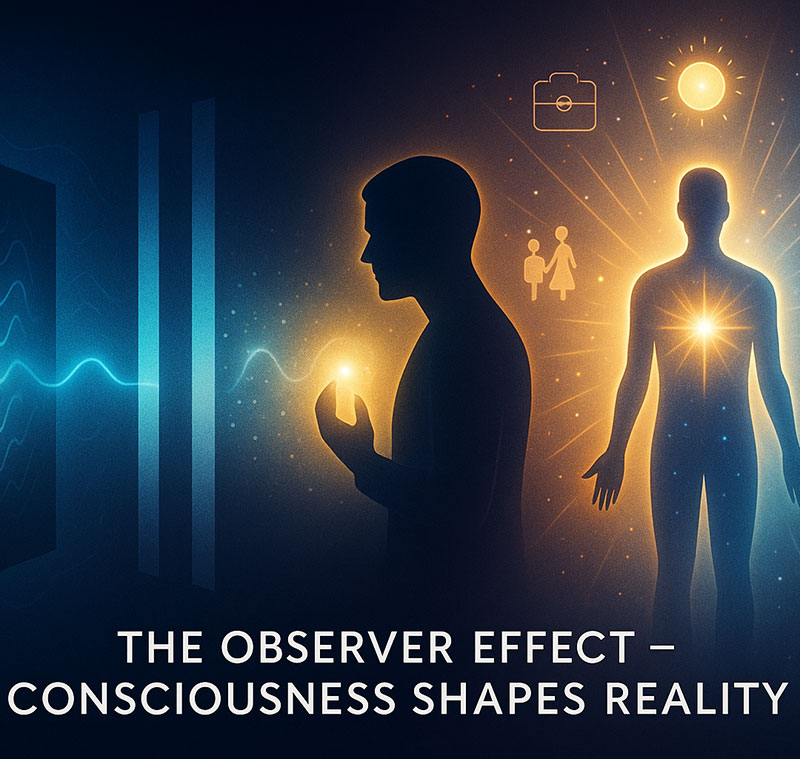
Electrons can be anywhere, at any time, existing as infinite possibilities. We cannot say the electron is always at the same place with the same speed and position at once. It can even exist in two different places at the same time — a phenomenon known in quantum physics as “superposition”. Therefore, until we measure them, they do not have any specified properties. Once the observer decides to search for electrons and measure them, the energy collapses with the observer effect and the electron is seen as a particle. When the observer effect is over, the electrons return to infinite possibilities. This is one of the main features of quantum physics.
When two photons (light particles) interact with or become linked to each other, if we separate them across great distances, whatever happens to one instantly affects the other. This is called Quantum Entanglement.
Everything in the universe has an energetic field, emanating energy frequencies or waves and also collecting vibrational waves from others’ fields. This connects everything and everyone with one another regardless of distance, like a wireless system. We are not only physical beings; we are also energy waves, vibrating at different frequencies related to our consciousness. We are particles of the universe, vibrating with infinite possibilities.
The quantum field is an invisible field of information that exists beyond space and time. It contains all possible frequencies, and each frequency carries information. Just because we cannot see the field does not mean it does not exist. We cannot see X-rays, infrared light, the Higgs boson or antimatter — but they all exist.
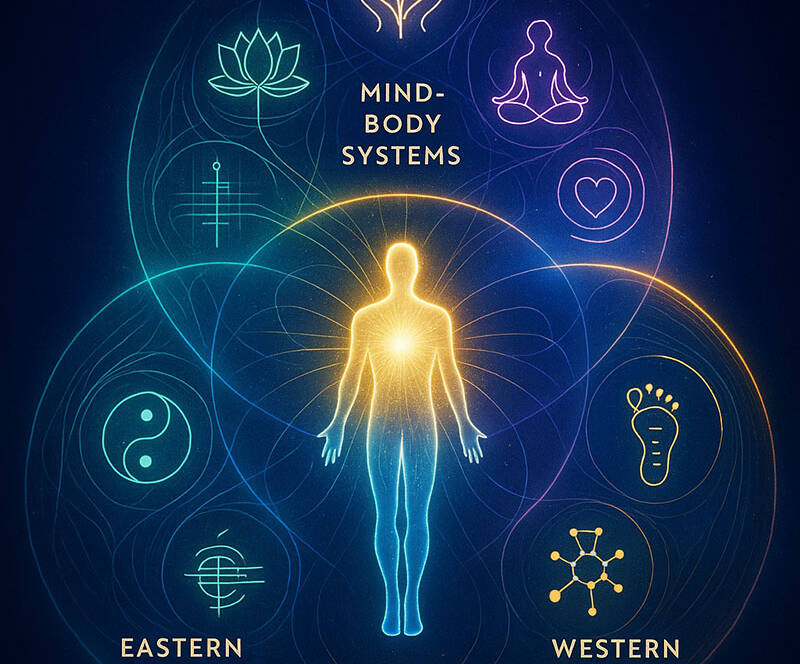
Energy therapies, especially distant healing, work primarily through the quantum field and energetic connections. Conventional physics is mainly based on matter and the interactions between material objects. But in quantum physics, it is based not only on matter, but also on the interaction between energetic fields and energy waves of matter. The moment that particles interact, their energy waves become connected as well. Therefore, when two people interact — mentally or physically — their energy waves and magnetic fields also connect. This happens within the quantum field.
The machines that image damaged tissues, like MRI, used in Western medicine, mainly work on the principles of quantum physics. The machine acts like a radio by sending and receiving energy signals to and from a person’s atoms (protons in body’s hydrogen nuclei). The energy signals are then read by a computer and converted into an image. We don’t visualise directly damaged cells or tissues, we detect the damaged cells’ energetic wave frequencies in the tissues.
Energy therapies aim to remove the blockages of disrupted energy waves by restorative energy frequencies to balance the energy pathways of the body, using wireless connections within the quantum field by consciousness.
In Western scientific field, there are some notable experiments. The one conducted by Dr. Randolph Byrd in 1982, involving 393 patients, which produced remarkable results showing that a group of people could facilitate healing without ever meeting or seeing the patients. Science itself is constantly evolving and making new discoveries.
Dr. Candace Pert. a neuroscientist and pharmacologist who conducted pioneering work in biochemistry, related to how emotions could be connected to biochemical changes in the body. Her research explored the ways that cells and receptors throughout the body communicate and “store” emotional information, which she described in her book Molecules of Emotion in 1997. In 2024, a team of scientists has discovered that cells from other parts of the body also perform a memory function. In the journal Nature Communications ’New York University’s Nikolay V. Kukushkin, explains that:
‘Learning and memory are generally associated with brains and brain cells alone, but our study shows that other cells in the body can learn and form memories, too. This discovery opens new doors for understanding how memory works and could lead to better ways to enhance learning and treat memory problems“.